India at an Inflection Point: A Strategic Growth Story Investors Can’t Ignore
Is India simply the fastest-growing major economy—or is it becoming the most important long-term growth story of our time? Jeffrey Sweeney explores how powerful demographics, accelerating infrastructure, and rising capital demand are converging to create a rare and durable opportunity for global investors.
 By Jeffrey Sweeney, Founder and Chairman, US Capital Global
India is increasingly moving from a promising emerging market narrative to a central pillar of global economic growth. For investors and institutions willing to take a long-term view, the country offers a powerful combination of demographic strength, structural resilience, and accelerating infrastructure development. At a time when many developed economies face structural constraints, India stands out not simply for its growth rate, but for the durability underpinning it.
A Structural Growth Story
India’s trajectory is being shaped by long-term fundamentals rather than short-term cycles. Most notably, the country benefits from a young and expanding workforce, in contrast to economies such as China that are now facing demographic headwinds. This provides a sustained foundation for consumption, productivity, and economic expansion over decades, reinforcing India’s ability to maintain momentum rather than experience episodic growth.
Consistent and Resilient Expansion
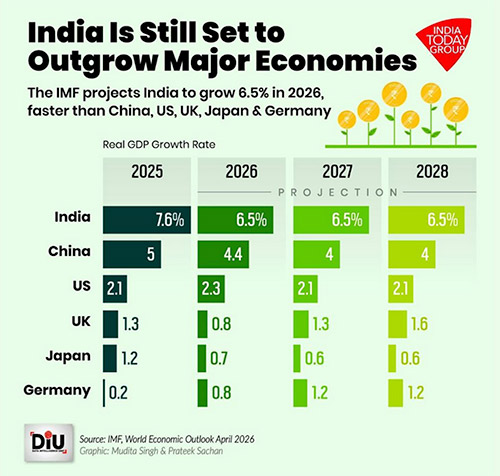
Recent forecasts reinforce this outlook. Goldman Sachs projects India’s real GDP growth at around 6.9% in 2026 and 6.8% in 2027, while the International Monetary Fund and United Nations agencies likewise anticipate sustained expansion in the mid-6% range. By contrast, global growth is expected to be about 3.1% this year. Equally significant is the durability behind these figures: India has shown a consistent capacity to grow through varied external conditions, underpinned by resilient domestic consumption and an increasingly diversified economic base.
Infrastructure as a Growth Engine
A defining feature of India’s rise is the scale and pace of its infrastructure development. The country is advancing a substantial infrastructure pipeline of approximately ₹35 trillion (around $375 billion), with investment expanding rapidly across transport, logistics, renewable energy, and digital systems. Projections suggest a further increase in infrastructure spending in the near term. While traditional sectors such as roads and real estate remain important, newer areas—including data centres, battery manufacturing, and smart energy systems—are beginning to play a larger role.
At the same time, India is addressing its energy requirements through diversification. Significant investment in solar and other renewable sources is helping to support industrial growth while also fostering new domestic industries. This dual approach—meeting demand while building capacity—adds an important layer of resilience to the broader economy.
Capital Formation and Opportunity
India’s growth is translating into tangible opportunities for investors. The country continues to attract substantial foreign direct investment, particularly in greenfield projects, while domestic capital markets are becoming more sophisticated. Increasingly, companies are seeking flexible and well-structured financing to support expansion.
At US Capital Global, we are already seeing this trend through engagements with Indian businesses, including in renewable energy manufacturing. We also have an affiliate presence in Mumbai supporting capital-raising activities, reflecting the growing demand for disciplined private capital in the market.
A Strategic Long-Term Presence
Given these dynamics, India represents a clear strategic priority for our firm. We are actively evaluating the establishment of offices in key cities such as Bangalore, Mumbai, and Delhi, with an initial presence expected later this year. Alongside this, we are considering how elements of our operational platform, including due diligence functions, can be efficiently supported from India as financial services continue to digitize.
This approach reflects a broader view: long-term growth in global finance will increasingly be aligned with markets that combine scale, talent, and sustained economic expansion.
Discipline in a High-Growth Market
As with any rapidly developing economy, India presents complexities. Infrastructure gaps, regulatory evolution, and global economic factors all require careful navigation. However, these challenges do not diminish the broader opportunity. Rather, they reinforce the importance of disciplined execution, local understanding, and a long-term perspective.
India’s rise is not a short-term trend but one of the defining economic developments of our time. For those willing to engage thoughtfully and strategically, it offers a compelling platform for sustained growth and investment over the years ahead.
Jeffrey Sweeney is a lifelong entrepreneur and successful fund manager with decades of experience in corporate finance and asset management. He is Founder and Chairman of US Capital Global ( www.uscapital.com), a full-service global private financial group headquartered in San Francisco with primary offices in Los Angeles, Philadelphia, New York, Miami, London, Milan, Zurich, Dubai, and Singapore.
 Download a PDF of this Press Release
Media Q&A / FAQs
What is this article about?
This article by Jeffrey Sweeney examines India’s long-term growth potential and explains why the country may represent one of the most important strategic growth stories for global investors.
Why does the article describe India as being at an inflection point?
The article argues that India is moving from a promising emerging market narrative to a central pillar of global economic growth, supported by demographics, infrastructure development, domestic consumption, and rising capital demand.
What demographic advantage does India have?
The article states that India benefits from a young and expanding workforce, creating a long-term foundation for consumption, productivity, and economic expansion.
What GDP growth forecasts are mentioned?
The article cites Goldman Sachs projections of India’s real GDP growth at around 6.9% in 2026 and 6.8% in 2027, and notes that IMF and United Nations agencies also anticipate sustained expansion in the mid-6% range.
How does infrastructure support India’s growth story?
The article highlights a substantial infrastructure pipeline of approximately ₹35 trillion, or around $375 billion, with investment expanding across transport, logistics, renewable energy, digital systems, data centres, battery manufacturing, and smart energy systems.
What role does renewable energy play in India’s development?
The article states that India is diversifying its energy base, with significant investment in solar and other renewable sources helping to support industrial growth while fostering new domestic industries.
How is India’s growth creating capital formation opportunities?
The article explains that India continues to attract substantial foreign direct investment, especially in greenfield projects, while domestic capital markets become more sophisticated and companies increasingly seek flexible financing for expansion.
How is US Capital Global engaging with India?
The article states that US Capital Global is seeing activity with Indian businesses, including in renewable energy manufacturing, has an affiliate presence in Mumbai supporting capital-raising activities, and is evaluating offices in Bangalore, Mumbai, and Delhi.
What challenges does the article identify?
The article notes that India presents complexities including infrastructure gaps, regulatory evolution, and global economic factors, which require disciplined execution, local understanding, and a long-term perspective.
Who wrote this article?
The article is written by Jeffrey Sweeney, Founder and Chairman of US Capital Global, who is described as a lifelong entrepreneur and fund manager with decades of experience in corporate finance and asset management.